
By John Fisher, Chief Executive
Housing Horizons Conference
CHIC hosted the Housing Horizons Conference jointly with the Housing Forum in March. I presented my thoughts on strategic asset management alongside Jenny Danson, CEO of the Healthy Homes Hub, who promoted the importance of good housing conditions to residents’ health.
Online Debate
Jenny has recently shared her thoughts with a post on LinkedIn, which has generated significant online debate. In short, she argues for access to the collection and use of data about individual residents’ (and families) health, acknowledging that GDPR might make this tricky.
The general reaction in the LinkedIn responses is that this approach would be too ‘big brother’, interfering in residents’ very personal space. This is perhaps a debate Jenny intended to initiate, to secure recognition about the importance of good housing to residents’ health.

Understanding Housing Performance
I agree wholeheartedly about the strength of the link between the quality of housing we provide as a sector to the health of the people occupying those homes. Better, warmer, home comfort should help residents to be healthier, whereas cold, damp homes with poorer facilities can directly affect both physical and mental health.
Of course it is not as simple as this. There is a whole range of other factors that can influence people’s health and wellbeing – but a decent, warm home is undoubtedly a positive factor in helping residents to stay fit and healthy.
Some of the responses to Jenny quite rightly identify that the sector already has significant amounts of data that should be influencing which homes need investing in, to make them healthier. I have long since promoted the importance of taking data out of silos and using it intelligently to drive strategic asset management – investing in the right homes at the right time.
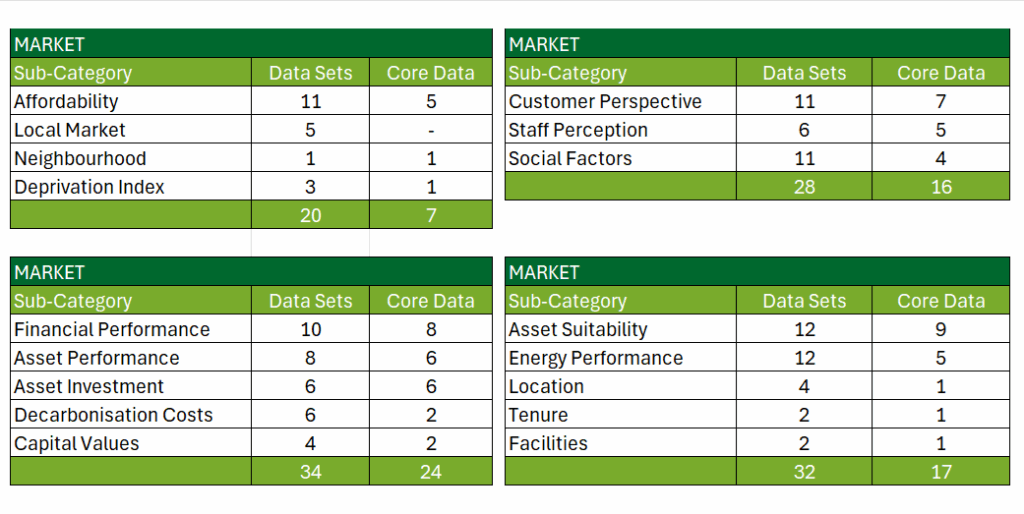
Without specific access to residents’ health records, they already tell us what they think. Data on stock turnover, void spend, complaints, occupation levels, repair demand lettings and so on already give accurate feedback through the residents’ lens. The tables below show the number of data sets that are available to landlords, much of them at property level, to inform asset management strategies:
The ARK ASAP model takes this data from individual silos, checks it, weights it and through a series of calculations creates an understanding of the relative strengths and weaknesses of the landlords homes. The graph below is a typical outcome, showing overall quality score horizontally and financial performance vertically:
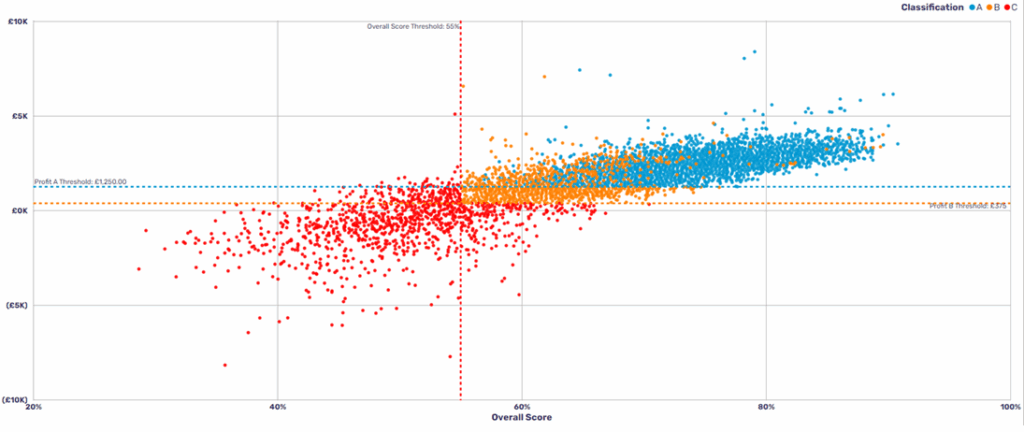
It should be no surprise that properties that score well are those where residents are happier, have less demand on their landlords and are thus financially more sustainable. The converse is true for those in poor condition, that residents don’t like and are more demanding both financially and operationally.
It is reasonable to assume that the residents in the first category (better homes/ less stress) are generally healthier and we don’t need their personal health data to confirm this. They are likely to be telling us this through their individual interactions with their landlord.
The sector has got better at using its data to invest in and maintain its housing intelligently, but we still have quite a way to go. Only when all homes are in the top right quadrant of the graph can we assume that all residents’ opportunities to live a healthy life will be helped in part by the quality of their housing. So, if your own asset management strategy doesn’t have this level of understanding about asset performance and a rolling investment strategy that pushes all homes top right, your data needs consolidating into an ASAP model.
Survey Overload
Many of the data sets included in ASAP are survey generated. The Regulator specifically encourages 5 year rolling programmes of stock condition data, so landlords understand what investment is needed where. But without more sophisticated modelling of this alongside other ‘people, financial and market data’, can asset performance be properly understood.
If we look at this through a residents lens the surveyor visits their property once every 5 years, finds out what’s wrong with it and then disappears. Do they get any follow up about what resultant investment is influenced by that visit?
To disrupt their quiet enjoyment of their home, we also carry out a range of other survey visits, which might include:
- Tenancy visits/inspections
- Gas servicing visits
- Electrical inspections
- Asbestos surveys
- Repair inspections
- Damp and mould surveys
- Complaints response inspections
- Fire risk assessments
- EPC assessment
- Energy surveys.
In almost every case somebody will visit and generally enter their home, collect information that is taken away but with limited feedback relative to how their home might be improved.
So What To Do?
For me there are two key opportunities:
- Completely restructure our approach to surveying, to undertake ‘super surveys’ on a periodic basis, to minimise disruption to residents but collect the maximum amount of information we can.
- Use that information as part of intelligent data analysis (the ASAP model) to drive prioritised, rolling planned and cyclical investment in peoples homes. And tell them what’s going to happen when, ideally as a feedback loop in relation to the ‘super survey’.
If we can do all this it will show a proactive, joined up approach to strategic asset management, respecting residents’ privacy but engaging with them as valued customers.
Over time, resultant housing quality should continually improve and residents’ chances to remain healthy are enhanced. We are unlikely to need data at a personal level as the trends in population health and wellbeing should be available through publicly available health authority data. In the meantime, some provocation from the Healthy Homes Hub to move the ‘good housing leads to good health’ debate forward should be seen as a positive influence.